
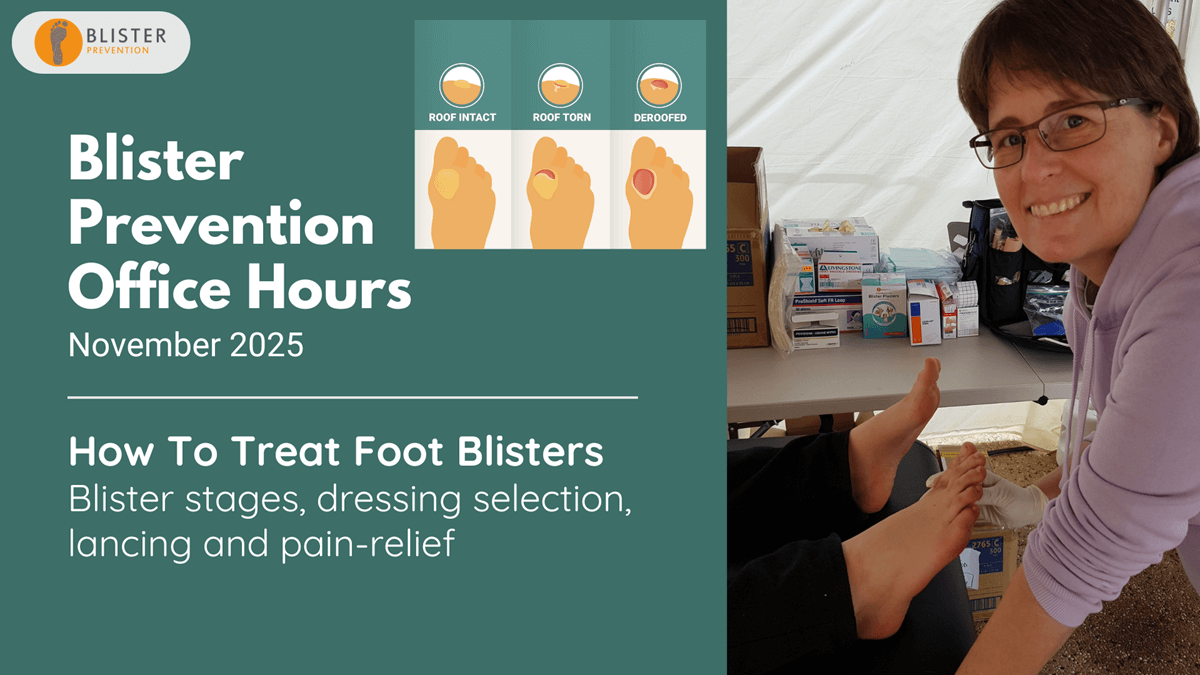
If you think blister care is all about dressing selection, you’re not providing meaningful blister treatment. As incongruous as it sounds, the real lever is prevention. That’s the critical piece of the “blister treatment equation,” and it matters at every stage: from hotspot management, to treatment of intact, torn, and deroofed blisters. First aid (antiseptic + a dressing) absolutely has its place in infection control. But, if your patient has to pull their shoes on and keep going, and you want to provide significant pain relief, and stop the blister from getting worse, and indeed help it get better by gaining healing momentum, in spite of ongoing activity, you need to stop the shear.
Let’s keep this succinct, clear, and practical.
Aims of Blister Treatment
- Prevent infection
- Stop the blister from getting worse
- Reduce pain
- Maintain healing momentum even if you have to keep moving
Blister care often gets overcomplicated with pdressing selection, or oversimplified down to “slap on a dressing.” The aim of treatment should be to tackle the cause, not just the consequences.
The Blister Treatment Equation
Blisters are caused by shear, which is internal soft tissue deformation. They are not necessarily caused by something “rubbing” your foot. A dressing will eliminate rubbing at the surface, but it doesn’t eliminate the internal shear deformation. That why blisters often continue to hurt and can even get worse inspite of having a dressing in place.
Prevention is the powerhouse here: strategies that reduce the magnitude of shear deformation. They allow less pain, less progression, more healing. This can look like deflective padding, taping, ENGO Patches, Spenco insoles, or biomechanical tweaks. I've discussed the various preventions in depth elsewhere, so won't go into detail here. Get the shear down, and the rest follows. This is the critical part of the blister treatment equation that is often missed, or left unoptimised.

Blister Stages and First Aid
The blister process has 5 stages:
- No blister
- Hot spot
- Intact blister
- Torn blister
- Deroofed blister
Take a look at the image below that outline what meaningful blister treatment looks like, but please watch the video for an in depth discussion and explanation.

Prevention at Every Stage
The best time to start prevention is at the blister-free stage. To do this, you predict your most likley blisters based on your blister history. Most people and even podiatrists ignore this, with unnecessary consequences.
The last reasonable chance for prevention is the hot spot - a short, subtle window of opportunity. Most people wait too long before doing something about it. They don't know it, but the intraepidermal tear has occurred and a blister is on its way (up to 2 hours for full blister filling).
Once a blister exists (intact, torn, deroofed), prevention still matters: lower shear magnitudes to reduce pain, halt progression, and support healing. This is the crux of the blister treatmet equation. Always aim for the best prevention you can find for the anatomical location, not just a token effort.
Predicting Blister Locations (Your Easiest Win)
Most people blister in the same place on their foot. They have a structural or functional predisposition to blisters at this site. This is called Blister History. Implement great prevention specific to these known sites ahead of blister formation if you can. This is the lowest-effort, highest-return strategy in the whole game. But it takes knowledge and preparation.
Three Common Misconceptions (Let’s Retire These)
-
Hydrocolloids work for every blister
- No, save them for deroofed blisters.
-
The dressing is the most important part
- It isn’t. Any island dressing will do the first-aid job. Implementing prevention during treatment is what changes the trajectory of outcomes.
-
Never pop a blister
- For weightbearing or athletic situations, controlled lancing of blisters can be the better option as it reduces the chance of a tearing within the germy in-shoe environment and may lower infection risk. However, a discussion must be had with your patient, informed consent obtained, and education around self-treatment obligations provided.
Pick Prevention by Anatomical Location (Not Activity or Climate)
Location is king. The site of the blister dictates the best prevention strategy far more than the activity or conditions. If you're in doubt, join Blister Prevention University, look up the site-specific playbook and match the method to the anatomy. That’s how you get meaningful pain-relief and healing momentum.
Bottom Line
First aid is important, but it is the smallest part of a larger blister treatment picture. Prevention heals! If you prioritise strategies that reduce shear, every other part of blister care gets easier: less pain, fewer complications, faster recovery, and far fewer repeat performances. Remember the Blister Treatment Equation: first aid + prevention = meaningful blister treatment.

Leave a comment
All comments are moderated before being published.
This site is protected by hCaptcha and the hCaptcha Privacy Policy and Terms of Service apply.